Why does the outer layer of a marshmallow toast differently to the lower layers? And other facts you may not have noticed about your marshmallow.
This is what the Marshmallow looks like straight from the bag.
As you can see the surface of the marshmallow is cracked and dry, this is due to it being coated in cornstarch. Not all marshmallows are coated in this but it is to preserve the marshmallow and make it easier to handle because if it did not have the protective layer it would be sticky and tacky, causing a lot of mess. According to both ‘The Chemical book’ and ‘Heavenly Bath’ the melting point of cornstarch is approximately 255 degrees centigrade and has a boiling temperature of 205 degrees centigrade.
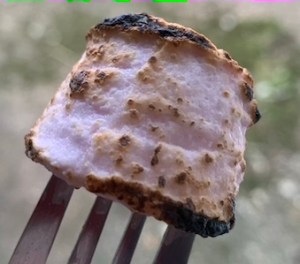
This is an image of the first layer after being toasted/ exposed to the flame this layer chars and catches fire easily and bubbles when burning.
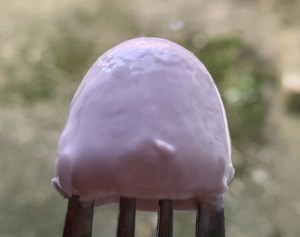
After peeling that first layer of the marshmallow off (once toasted) the marshmallow looks like this… its surface is smoother and softer than the first outer layer. This is the sugar and gelatine surface which is what the marshmallow is typically made of. It is smoother because it doesn’t have the dried cornstarch exterior unlike the first layer. This is the image is what the marshmallow would look like if it didn’t have the cornstarch coating to begin with.
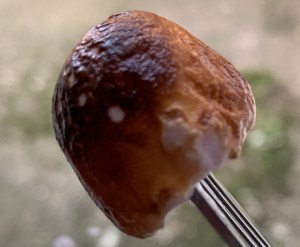
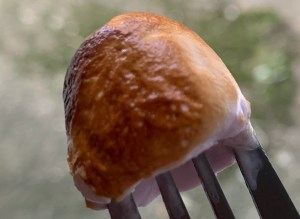
These two images are showing what the second layer looks like once toasted/ exposed to heat. This looks very different to the starch layer and that is because sugar has a very different melting/boiling temperature to cornstarch. The reason the colour changes is because the sugar is turning from ‘crystalline’ to ‘molten’ Fine Cooking Editors 2020. which is the process of caramelisation. It is a smoother more even colour due to the texture of the surface and the difference in moisture from the dry cornstarch and the sticky sugar. The temperature that sugar caramelises is 160 degrees centigrade (320 degrees Fahrenheit).
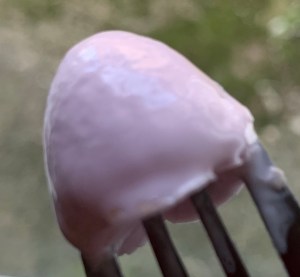
This photo is similar to the one above however is the layer under the caramelised layer, this is to show that it is only the first outer layer that has the cracked and dry texture and burns unevenly and bobbly, and the rest are smooth and sticky.
This would be a very good and engaging way to teach children about different chemical compounds, melting and burning points and also information about food production and why some foods are the way they are. Although the children are most likely to have had a marshmallow before it is such a mundane object they would not have thought about the science and how interesting they really can be making this a very enriching learning experience for them. It is also a very accessible experiment for them to re-create at home (with parent supervision around a flame obviously). This is also a form of teaching that children will not reject as they will be too engrossed in the practicality of it to recognise how deep their learning it actually going, making it more accessible to the different learning needs of the pupils you will face as a teacher, due to the practicality of this learning episode it will allow the children who struggle with the abstracts of science to understand it as it is in a much more physical form. Finally, the information and experiment with marshmallows can be done in a forest school with a fire or can be completed in a classroom with Bunsen burners or at home with a gas hob and in very desperate times can be done with any disposable lighter (although it is not recommended).
- References for page…
- Heavenly Bath (No Date) Physical properties: Cornstarch Available at: https://alisbathbomblab.weebly.com/physical-properties.html (Accessed 16 March 2020)
- Chemical Book (2017) 9005-25-8 (starch Product description Available at: https://www.chemicalbook.com/ChemicalProductProperty_US_CB8349543.aspx (Accessed on 16.03.2020)
- Fine Cooking (2019) The Science of Caramel Available at: https://www.finecooking.com/article/the-science-of-caramel (Accessed 23 March 2020)
- All images taken by Caitlin Jardine 2020
 Caitin's Science Blog
Most marshmallows are not vegetarian. But you *can* get vegetarian marshmallows in Holland & Barrett. How are they different, and why don’t manufacturers simply stick to making vegetarian marshmallows? It would save a lot of trouble around the camp fire…
LikeLike
It would be really interesting to see you go even further into the science of all of this. What would “A Scientist’s Account of Marshmallows” say? For me, some diagrams or even chemical equations might help!
It is always a challenge when you try to understand the science from non-science sources like cooking and bath bomb websites, because often terms that look “scientific” are used incorrectly. You need to be careful as a science-literate author to “translate” the everyday language into precise science language. It is safer to find a scientifically-valid source in the first place.
Having said all this, I look forward to my next marshmallows and will really annoy people around me by exploring the marshmallows far too long before enjoying them 🙂
LikeLike